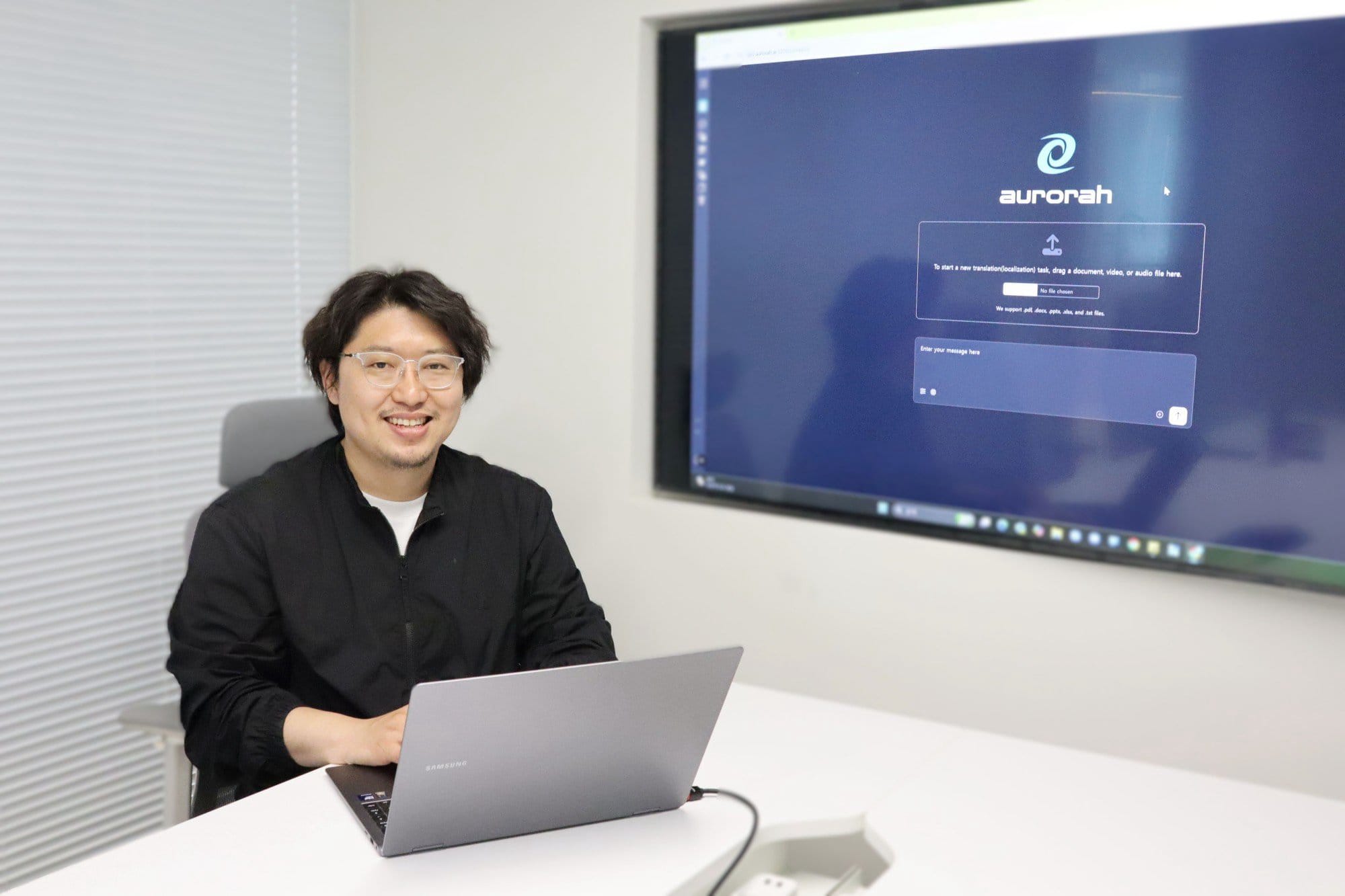
HiveMind (CEO Warren Kim) announced on August 10 the official release of @aurorah/i18n, a developer library for software localization.
The launch marks the first time HiveMind has extended the AI translation technology accumulated in Aurorah — its localization platform for story content such as web novels — into the software development domain, and is expected to sharply reduce the localization burden for Korean software companies preparing to go global.
Until now, developers offering software in multiple languages had to create and manage per-language translation keys in separate files. Whenever new copy was added or code was refactored, key values frequently drifted out of sync or went missing, making localization maintenance costly and time-consuming.
@aurorah/i18n removes that key-management process entirely. The string written in the source code becomes the key itself: developers simply write code as they always do, and the copy is processed automatically and translated in real time. With no separate onboarding procedure or complex configuration, a single package install is enough to launch a multilingual service immediately.
The library is designed so that AI generates a first-draft translation in real time, continuously refines its quality in the background, and pins human-reviewed translations where needed. It supports major web frameworks including Next.js and SvelteKit, as well as React, Lit, Node.js, and vanilla JavaScript environments, and automatically handles language-specific rules — plurals, gender, dates, and number formatting — based on the ICU MessageFormat standard.
Notably, companies using existing catalog-based libraries such as i18next or react-intl can migrate without any re-development. Existing JSON translation files can be imported and used as a translation cache, and existing ICU syntax and translation-key structures remain fully compatible — remove the key files, and the transition is complete.
@aurorah/i18n is built on a translation engine already proven in production inside Aurorah, HiveMind’s story-content localization platform. The same two-phase translation pipeline — tuned to capture the subtle nuances and honorific systems of Korean, Japanese, and English — is applied identically to software products, a meaningful extension of the technology accumulated in content localization into the software market.
According to market research firm Allied Market Research, the global software localization market is projected to grow to US$15.6 billion (about KRW 21 trillion) by 2032. The market has long been led by paid, catalog-based approaches, with translation management systems (TMS) and specialist agencies charging per word or per key. i18next, the leading catalog-based library, alone exceeds 20 million weekly downloads on npm — a measure of how large the potential market for replacing key management could be.
If approaches like @aurorah/i18n — where the source string itself is the key and the translation engine is provided free — take hold, analysts suggest the market’s center of gravity could shift toward a model where developers complete multilingual support the moment their product ships, without separate costs or vendor contracts. The engine has initially been released with ICU MessageFormat standard support at its core; HiveMind plans to progressively expand tutorials and documentation to ease adoption, add advanced features such as type-safe code generation, and build an open-source developer community where engineers can improve the library together.
“We released our in-house localization engine as open source so that any small or mid-sized Korean software company can use it freely and conveniently,” HiveMind said. “The goal of this release is to let teams pour the time and money they used to spend on translation-key management entirely into product development.” The company added, “We will continue expanding technical support in software localization so that companies can take on overseas markets right away — without localization standing in the way.”
 HiveMind